The Eastern Pacific Green Turtle
Chelonia Mydas
By Sam Korff
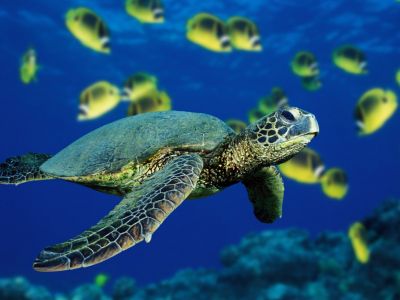 |
| The Endangered Green Sea Turtle © 2018 (Animal Spot) |
Description and Ecology
The green sea turtle (Chelonia mydas) is a widespread population of marine reptile initially described by Carl Linnaeus as Testudo mydas in 1758. More specifically, the East Pacific Green Turtle is a highly migratory subspecies concerned in areas such as Hawaii and along the west coast of North America where it can travel thousands of miles to breed and feed. It is different from the green sea turtle in both size, and shape, where it’s average size, is about 3 feet long weighs around 300 pounds. This makes the eastern Pacific green turtle smaller, weigh less, and have a narrower upper shell than other regions of green sea turtle. The diet and habits of green sea turtles change as they age; they lay eggs/are born on beaches, the young are carnivorous, but as they mature and move into deeper coastal waters they become omnivorous until eventually most adult sea turtle become strictly herbivorous.
Geographic and Population Changes
 | |
|
Listing Date and Type of Listing
 |
| Official Listing on ECOS © https://ecos.fws.gov/ |
In recent decades the species has moved from unrestricted exploitation to global protection, yet intentional and unintentional means leave the wild populations of the species facing a high risk of extinction. The east pacific green turtle was listed in the U.S. Endangered Species Act (ESA) of 1973 as endangered across its’ range. All populations of chelonia mydas are classified as Endangered in the International Union for Conservation of Nature and Natural Resources' (IUCN) Red List and the Convention on International Trade in Endangered Species (CITES). The eastern Pacific, Hawaiian and Southern California sub populations are designated threatened.
Cause of listing and Main threats to its continued existence
 |
| Plastic pollution entangles turtles and can be mistaken for food © 2016 (Sergi Garcia) |
From eggs to adults, green sea turtles are vulnerable to many threats including commercial harvest, incidental harm/bycatch, degradation of their habitat, pollution, and illegal trading. The population has exhibited a clear decline in numbers over the last 40 years and a more extreme decline in the last 30 years. Primary threats to the eastern green turtle subspecies in U.S. waters are from entanglement in debris and boat collisions. Primary threats in Mexico are the (illegal) harvest of turtles and eggs for leather and the exotic pet trade. Every year worldwide, hundreds of thousands of sea turtles are victims of bycatch caused by commercial fishing, where they are caught in shrimp trawl nets, longline hooks, and in fishing gillnets. Additionally, the Convention on International Trade in Endangered Species of Wild Fauna and Flora (CITES) prohibits the international trade in all sea turtle species and their parts, yet illegal trafficking persists.
Description of Recovery Plan
 |
| Green turtle being treated for a 6-inch split in her shell caused by boat collision © The Turtle Hospital |
There is a total of 6 recovery plans for the green sea turtle, where the most recent recovery plan describes US Pacific and East Pacific regional populations. The Recovery Plan for U.S. Pacific Populations of the East Pacific Green Turtle was created in 1998, and outlines the major actions needed to achieve recovery. The primary action is to prevent incidental mortalities by commercial fishing operations, and boat collision, particularly within San Diego County, California. The next important action is political, to support the efforts of Mexico and the countries of Central America to census and protect nesting East Pacific green turtles, their eggs, and nesting beaches. The last actions are to determine important information on the population size and status in the U.S., the home ranges, and identification and protection of primary forging areas in the U.S.
What can you do?
It is very important that you continue the education of yourself and others about this topic in order to become activists for it, so you're already doing a great job! Also, it's very important to consider your own ecological footprint; particularly with plastics and other non-biodegradable resources that could potentially end up in our waterways. Political solutions will be the most practical solves to stopping the pollution and habitat degradation, but other more fun activities can involve Ecotourism based on sea turtles to help protect them.
 |
| © thelastplasticstraw.org |
Want to learn more? Here are some additional resources!
References:
Seminoff, J.A. (Southwest Fisheries Science Center, U.S.). 2004.Chelonia mydas. The IUCN Red List of Threatened Species 2004: e.T4615A11037468.
Recovery Plan (1998) - East Pacific Green Turtle - NOAA Fisheries. ecos.fws.gov/docs/recovery_plan/981201f.pdf.
Recovery Plan (1998) - Pacific Green Turtle - NOAA Fisheries. ecos.fws.gov/docs/recovery_plan/981201f.pdf.
“Recovery plan for U.S. Pacific populations of the East Pacific green turtle (Chelonia mydas) /.” 1998, doi:10.5962/bhl.title.62214.
“Sea Turtle.” WWF, World Wildlife Fund, www.worldwildlife.org/species/sea-turtle.
Service, U.S. Fish and Wildlife. Species Profile for Green sea turtle (Chelonia mydas), ecos.fws.gov/ecp0/profile/speciesProfile?spcode=C00S.
US Department of Commerce, NOAA, National Marine Fisheries Service. “Home page of NOAA Fisheries Service - Pacific Islands Regional Office.” Green Sea Turtle :: NOAA Fisheries Pacific Islands Regional Office, 21 June 2006, www.fpir.noaa.gov/PRD/prd_green_sea_turtle.html.
Amorocho, Diego F., et al. “Multiple Distant Origins for Green Sea Turtles Aggregating off Gorgona Island in the Colombian Eastern Pacific.” PLOS ONE, Public Library of Science, journals.plos.org/plosone/article?id=10.1371%2Fjournal.pone.0031486.
Armstrong, Dave. “Endangered green turtle migration mapped.”The Earth Times, 22 Feb. 2012, www.earthtimes.org/nature/green-light-migrating-turtles/1806/.

It is so sad that one of their reasons for endangerment is due to people taking the eggs before they are born or selling the young into the illegal pet trade. Hopefully by informing more people in other countries, where the eggs are a delicacy, of their endangerment, they can soon be taken off the red list. - Samantha Jones
ReplyDeleteI am so glad that they have several recovery plans for these green seas turtles. The incidental casualties is so sad. These turtles did not evolve knowing to look out for boats. I also hope the political action to stop illegal trade and harvesting of the eggs makes a difference! -Kylie Kuwada
ReplyDeleteThere are a lot of reasons that this turtle is on the endangered species list like degradation of their habitats, by catch, and illegal trading, but I think the one we can most easily stop is pollution. If we all recycle and do our part we can hopefully reduce the risk of turtles getting stuck in pollution in the ocean. -Allie Jones
ReplyDeleteGreat information...Sea turtles are beautiful creatures. Another way to help reduced ocean plastic can be to switch to re-usable alternatives like tupperware, wooden utensils and metal straws! -Chloe Knowd
ReplyDeleteI found it very interesting how much they diet of the Eastern Pacific Seat Turtle changes throughout their lifetime from carnivore to strictly herbivore. I had never heard of anything like that before. It is so sad that bycatch and entanglement are such a threat to these beautiful creatures, especially because these threats are a direct result of human actions. I hope initiatives that discourage the use of plastic straws, cups, etc. will help this species recover in the near future. - Melanie Jenkins
ReplyDeleteIts horrible to hear that the Eastern Pacific Green Turtle is hunted for leather. I think that the recovery plan describes a lot of actions that can potentially help the turtles. I think we should also look at out own ecological footprint, such as the amount of plastic we use. Especially because plastic is also a threat. - Courtney Koyama
ReplyDeleteThis poor animal has so many threats to its existence. Unlike other species discussed so far, this turtle must be protected in so many ways. It will be difficult to keep it off the endangered species list. - Shea Irwin
ReplyDeletePersonally I love turtles, and the fact that sea turtles have been on the endangered list for so long makes me so sad. Even though they live one of the longest lives out of any species, they still face so many problems. Hopefully more awareness for these creatures gets them off the endangered list. -Jennifer Jaing
ReplyDeleteThe map showing their migratory patterns was super interesting. How the range in which they traveled seemed to increase with time. Also the fact that the babies are carnivores and once they become adults they are strictly herbivores. -Carolyn Inglis
ReplyDelete